
Colonial Scrip and Dominion Notes 1700-1934
The history of Canadian currency prior to 1934 is a chronicle of desperate improvisation, failed experiments, and the slow, painful realization that a modern nation requires centralized monetary management. Long before the Bank of Canada opened its doors, the colonies that would become Canada oscillated between severe currency absence and rampant inflation, frequently at the mercy of distant imperial treasuries.
In June 1685, Jacques de Meulles, the Intendant of New France, faced a payroll emergency. The annual shipment of funds from France was late, and his troops were on the verge of mutiny. His solution was not born of financial innovation of need: he requisitioned playing cards, cut them into quarters, signed them, and declared them legal tender. This "card money" was intended as a temporary expedient, yet it for decades. The system relied entirely on the confidence that the French Crown would eventually redeem the paper for hard specie. Frequently, this confidence was misplaced. By 1714, over 2 million livres of card money circulated, far outstripping the colony's economic output. The inevitable correction came in 1717, when the French government ordered a redemption at 50 percent of face value, a state-sponsored default that wiped out half the paper wealth of the colony. The pattern repeated during the Seven Years' War, ending in an even more catastrophic liquidation in the 1760s where paper assets became worthless after the British Conquest.
Under British rule, the monetary terrain remained chaotic. Accounts were kept in pounds, shillings, and pence, yet the actual coins in circulation were a motley collection of Spanish dollars, Portuguese joes, and French crowns. To bring order to this confusion, colonial authorities established the "Halifax Rating," a valuation system that pegged the Spanish dollar at five shillings. This accounting fiction allowed trade to function even with a chronic absence of British coinage. The most successful paper currency experiment of this era arrived during the War of 1812. The Army Bill Office in Quebec issued £3. 44 million in paper notes to finance the defense against American invasion. Unlike the card money of New France, these bills were fully redeemed by the British Treasury between 1815 and 1817. This success proved that paper money could be stable if backed by a credible sovereign commitment, a lesson that would take another century to fully institutionalize.
The establishment of the Bank of Montreal in 1817 marked the beginning of the chartered bank era. Private banks began issuing their own notes, which circulated as currency. These notes were theoretically convertible into gold or silver on demand, the system was fragile. If a bank failed, the paper in a citizen's pocket became worthless. The colonial government attempted to assert control through the Free Banking Act of 1850, modeled on American legislation, it failed to gain traction. A more significant shift occurred with the Provincial Notes Act of 1866 and the subsequent Dominion Notes Act of 1870. These laws created a dual system: the government issued small-denomination notes (under $4), while chartered banks issued larger notes. The 1870 Act imposed a strict discipline: the $9 million of Dominion notes were backed by a 20 percent gold reserve. Any issuance above this cap required 100 percent gold backing. This method tied Canada's money supply directly to its gold reserves, prioritizing stability over flexibility.
The rigid discipline of the gold standard was shattered by the World War. In 1914, the federal government passed the Finance Act, a measure that fundamentally altered the monetary structure. To finance the war effort and prevent a banking panic, the Act suspended the convertibility of Dominion notes into gold. More importantly, it allowed chartered banks to borrow Dominion notes from the Department of Finance by pledging securities as collateral. This created a method for expanding the money supply without a corresponding increase in gold reserves. The Finance Act functioned as a discount window, allowing the government to act as a lender of last resort, it absence a central intelligence to manage the flow. There was no central bank to raise interest rates or curb lending when the economy overheated. The result was unmanaged inflation during the war and a severe deflationary contraction in the early 1920s.
The structural flaws of this decentralized system were laid bare by the collapse of the Home Bank of Canada on August 17, 1923. The bank, based in Toronto with strong ties to the prairie provinces, had engaged in reckless lending and speculative real estate ventures. When it failed, thousands of depositors, of them prairie farmers, lost their life savings. The political was intense. The failure revealed that the Canadian Bankers Association, which was supposed to self-regulate the industry, was powerless to prevent insolvency. Public anger mounted against the "money power" of the eastern banks, fueling agrarian populist movements that demanded government intervention in the credit system.
The Great Depression delivered the final blow to the existing order. As Canada's economy contracted by nearly 40 percent between 1929 and 1933, the rigidity of the banking system and the absence of a central monetary authority became impossible to ignore. In 1933, Prime Minister R. B. Bennett appointed a Royal Commission on Banking and Currency, chaired by Lord Macmillan, a British jurist. The Macmillan Commission became a battleground between the old guard and the reformers. The Canadian banking establishment, represented on the commission by Sir Thomas White and Beaudry Leman, vehemently opposed a central bank. They argued that Canada's banking system had survived the Depression better than the United States, where thousands of banks had failed. They viewed a central bank as an unnecessary political intrusion.
Lord Macmillan and the other commissioners disagreed. They recognized that the Finance Act provided the for credit expansion absence the brakes. The final report, released in late 1933, recommended the establishment of a central bank by a narrow 3-2 vote. The report argued that Canada needed a national institution to manage the currency in the public interest, mitigate fluctuations in the general level of production and trade, and represent Canada in international financial negotiations. The dissenting opinion from the Canadian bankers warned of the dangers of political control over money, a tension that would define the institution's future.
| Period | Instrument | Issuer | Backing method | Outcome |
|---|---|---|---|---|
| 1685-1760 | Card Money | New France (Intendant) | French Treasury pledge | Severe Inflation & Default |
| 1812-1815 | Army Bills | Army Bill Office | British Treasury | Full Redemption (Success) |
| 1817-1934 | Bank Notes | Chartered Banks | Bank Assets / Gold | Occasional Bank Failures |
| 1870-1914 | Dominion Notes | Gov. of Canada | Gold (20% to 100%) | Price Stability / Rigidity |
| 1914-1934 | Finance Act Notes | Gov. of Canada | Securities Pledged by Banks | Unmanaged Inflation/Deflation |
The Bank of Canada Act received Royal Assent on July 3, 1934. It marked the end of the era of decentralized note issuance and the beginning of managed currency. The Act mandated that the new bank would eventually replace all private bank notes with its own, unifying the currency under a single authority. It was a victory for the reformers and a direct response to the devastation of the Depression. The chaotic experiments of the past, from the playing cards of Jacques de Meulles to the unanchored expansion of the Finance Act, had coalesced into a formal structure designed to regulate the nation's economic pulse.
The Macmillan Commission and Bank of Canada Act 1934
| Commissioner | Role / Background | Vote | Rationale |
|---|---|---|---|
| Lord Macmillan | Chairman, Scottish Jurist | For | Favored British model of central banking; saw need for unified credit control. |
| Sir Charles Addis | Director, Bank of England | For | Advocated for international monetary cooperation and centralized reserves. |
| John E. Brownlee | Premier of Alberta | For | Represented western farmers; demanded relief from deflation and bank control. |
| Sir Thomas White | Ex-Finance Minister | Against | Defended Finance Act; argued central bank was unnecessary and ill-timed. |
| Beaudry Leman | Banker (BCN) | Against | Feared federal overreach; protected chartered banks' note-issuance profits. |
Nationalization and Transfer to Crown Ownership 1938
The Bank of Canada began its existence in March 1935 not as a sovereign arm of the state, as a privately owned corporation. This brief, anomalous period stands in sharp contrast to the modern understanding of central banking in Canada. At its inception, the Bank issued $5 million in capital stock, divided into 100, 000 shares with a par value of $50 each. These shares were sold to the general public, not the government. To prevent any single financial interest from dominating the institution, ownership was widely dispersed; no individual could hold more than 50 shares. The shareholder list included clerks, farmers, and widows, a deliberate move by Prime Minister R. B. Bennett to insulate the Bank from political pressure. Bennett feared that a government-controlled bank would succumb to the temptation of printing money to fund deficits, a practice that had decimated European economies just a decade prior.
Yet, the optics of a private central bank during the Great Depression proved politically toxic. As unemployment soared and deflation ravaged the prairies, the public grew increasingly hostile toward the "money power" of Toronto and Montreal. William Lyon Mackenzie King, leader of the Liberal opposition, seized upon this anger. He framed the private ownership of the central bank as an abdication of national sovereignty. During the 1935 election campaign, King delivered one of the most defining statements in Canadian monetary history: "Once a nation parts with the control of its currency and credit, it matters not who makes that nation's laws. Usury, once in control, wreck any nation. Until the control of the problem of currency and credit is restored to government and recognized as its most conspicuous and sacred responsibility, all talk of the sovereignty of Parliament and of democracy is idle and futile."
King's landslide victory in October 1935 signaled the end of the private experiment, though the transition occurred in two distinct phases. The step came in 1936, when the new Liberal government amended the Bank of Canada Act to dilute private influence. The government issued $5. 1 million in new Class B shares, which were purchased entirely by the Minister of Finance. The original private shares were reclassified as Class A. This maneuver gave the government 51 percent ownership and, more importantly, the power to appoint the majority of the Board of Directors. For two years, the Bank operated under this awkward hybrid structure, with private shareholders receiving dividends while the government held the reins of policy.
The final move to total state control arrived in 1938. The government determined that the hybrid model was insufficient to guarantee the primacy of public interest over private profit. Parliament passed legislation to nationalize the Bank completely. The Ministry of Finance bought out the Class A shareholders, paying $59. 20 per share, a premium over the $50 par value that reflected the average market price of the stock during 1938. This transaction cost the treasury approximately $5. 92 million secured absolute ownership. On August 15, 1938, the private shares were redeemed, and the Bank of Canada became a Crown corporation, wholly owned by the people of Canada through their government.
Graham Towers, the Bank's Governor, navigated this ideological shift with remarkable pragmatism. Originally appointed by Bennett to lead a private institution, Towers accepted the nationalization without public protest. He understood that the legitimacy of the central bank depended on its alignment with the democratic, especially in an era of economic emergency. Towers remained in his post until 1954, proving that a central banker could maintain operational independence even while serving a government owner. His continuity ensured that the technical competence of the Bank survived the political upheaval of its ownership transfer.
The nationalization of 1938 aligned Canada with a growing global trend, though it preceded the nationalization of the Bank of England by eight years. The move fundamentally altered the Bank's mandate. No longer beholden to private shareholders expecting a return on investment, the Bank could focus exclusively on its statutory goal: to regulate credit and currency in the best interests of the economic life of the nation. The profit motive was legally extinguished; all profits after reserves were remitted directly to the Receiver General of Canada.
| Year | Ownership Structure | Capital Stock | Control method |
|---|---|---|---|
| 1935 | 100% Private | $5, 000, 000 (Class A) | Shareholders elect Directors |
| 1936 | Mixed (51% Public) | $10, 100, 000 (Class A + B) | Govt appoints majority of Board |
| 1938 | 100% Public (Crown) | $5, 000, 000 (Govt held) | Govt appoints all Directors |
This transfer of power had immediate practical. With the government as the sole shareholder, the Bank began to coordinate more closely with the Department of Finance, a relationship that would prove important during the financing of the Second World War just a year later. The fear of political inflation that Bennett had harbored did not materialize in the way he predicted; instead, the Bank used its powers to manage the yield curve and facilitate the massive war bond drives that mobilized the Canadian economy. The 1938 Act established the legal architecture that remains in place today: a central bank that is state-owned operationally distinct, designed to serve the public good rather than private capital.
Wellington Street Headquarters and Arthur Erickson Renovations
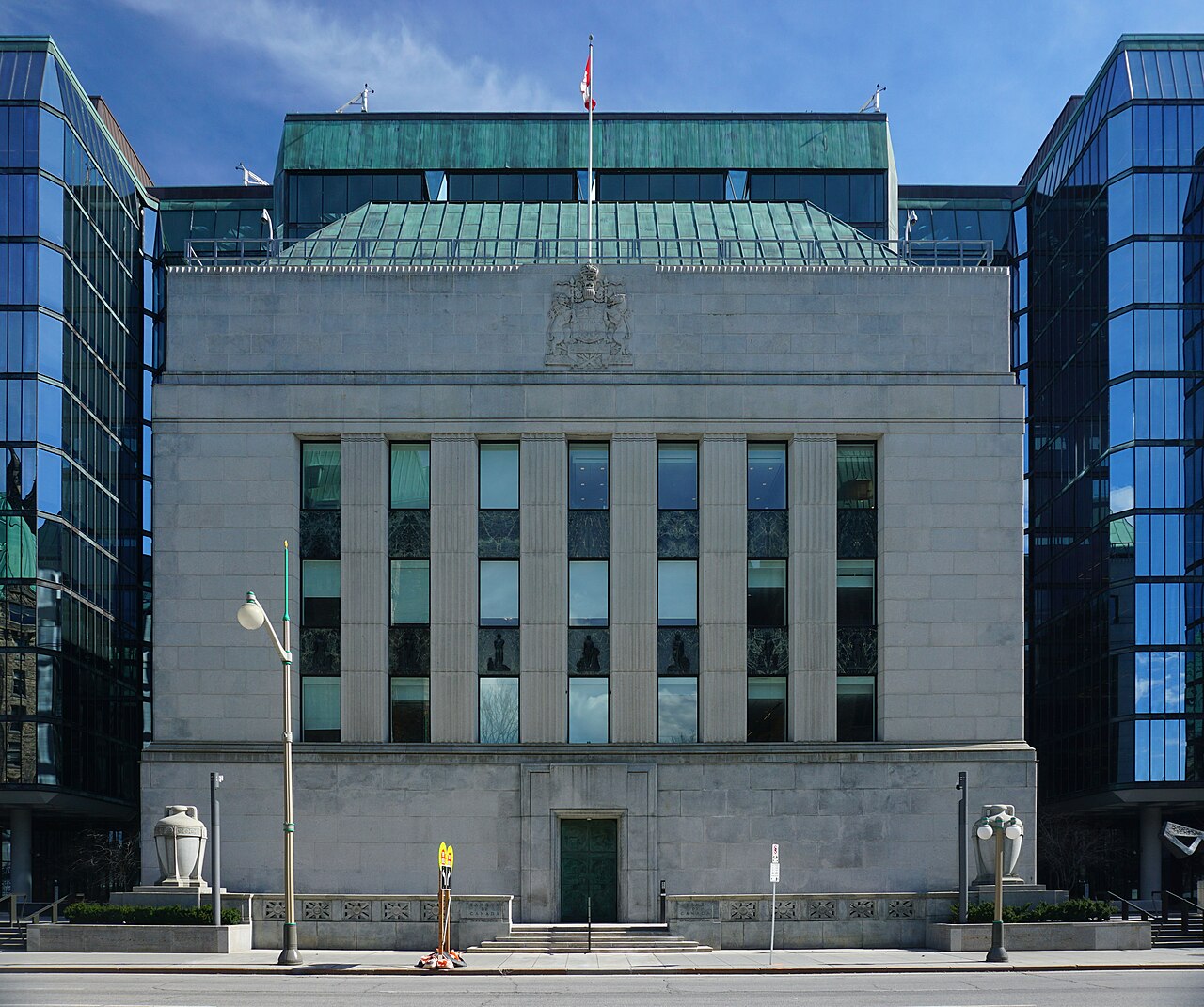
| Era | Architects | Key Features | Primary Focus |
|---|---|---|---|
| 1938 | Marani, Lawson and Morris | Grey granite, stripped classical, bedrock vault | Security, Stability, Austerity |
| 1979 | Arthur Erickson | Glass towers, 80m atrium, tropical garden | Transparency, Modernity, Space |
| 2017 | Perkins+ | Seismic retrofit, double-skin glass, plaza museum | Sustainability, Safety, Resilience |
Security requirements in the post-9/11 era also dictated changes to the public interface. Erickson's original design allowed relatively free public movement through the atrium. The renewal hardened the perimeter. The Bank of Canada Museum, previously located inside the secure zone of the main building, was relocated to a subterranean space beneath the granite plaza at the corner of Bank and Wellington Streets. Visitors enter through a glass pyramid structure, descending into galleries that display the National Currency Collection. This separation allows the Bank to maintain high-level security for its operations while keeping its educational mandate accessible to the public. As of 2026, the complex functions as a fully modernized facility. The integration of the 1938 granite core with the 2017 high-performance glass envelope represents the dual nature of the institution: a foundation in hard assets and history, encased in a modern framework of data and transparency. The gold vault remains, though largely empty of the bullion that once anchored the currency, serving instead as a artifact of a bygone monetary standard. The building itself, rated LEED Gold, operates with a reduced carbon footprint, reflecting the Bank's pivot toward analyzing climate change as a widespread financial risk. The physical plant at 234 Wellington Street stands not just as an office for economists, as a hardened piece of serious infrastructure, engineered to withstand seismic shocks and secure the digital and physical of the Canadian economy.
The 1961 Coyne Affair and Governor Resignation
The collision between Prime Minister John Diefenbaker and Bank of Canada Governor James Coyne in 1961 remains the most violent institutional rupture in Canadian financial history. It was not a disagreement over interest rates; it was a constitutional brawl that tested the limits of central bank independence and the supremacy of elected government. The conflict, frequently sanitized in textbooks as a policy dispute, was in reality a vicious personal and ideological war that ended with a governor's public execution and a permanent rewriting of the Bank of Canada Act.
James Elliott Coyne, appointed Governor in 1955, was a man of rigid intellect and unyielding principle. A Rhodes Scholar and economic nationalist, Coyne believed deeply that Canada was "living beyond its means," relying too heavily on American capital and foreign debt to finance its post-war expansion. His prescription was severe: tight money, high interest rates, and fiscal austerity. This philosophy might have survived in a booming economy, yet by the late 1950s, Canada had entered a stubborn recession. Unemployment climbed steadily, reaching over 7 percent by the end of 1960, a figure then considered politically catastrophic.
The Diefenbaker government, elected in 1957 and re-elected with a massive majority in 1958, ran on a populist platform of northern development and economic expansion. They needed cheap credit to fulfill their campaign pledge. Coyne gave them the opposite. Even as the economy softened, Coyne kept interest rates high to fight what he perceived as latent inflationary pressures and to discourage foreign borrowing. The result was a paralysis in policy: the government stepped on the gas with deficit spending, while the Bank of Canada slammed on the brakes with monetary restriction.
Finance Minister Donald Fleming found himself in an impossible position. For years, the government had relied on a convenient fiction regarding the Bank's status. When pressed by the Opposition about high interest rates, Fleming and Diefenbaker argued that the Bank of Canada was entirely independent and that the government had no legal authority to direct its operations. This "hands-off" doctrine allowed the government to disclaim responsibility for unpopular credit conditions. as the recession deepened and Coyne refused to yield, the government's political shield became a trap. They could not force Coyne to lower rates, nor could they admit they were powerless to manage the national economy.
Coyne did not remain silent. Breaking with the tradition of central bank reticence, he embarked on a cross-country speaking tour in 1960 and early 1961. He delivered speeches warning of the dangers of foreign ownership and the moral failing of debt. To the Diefenbaker cabinet, these speeches looked like an open political challenge. The Governor appeared to be running a shadow government, lecturing the electorate on the failures of their elected representatives. Diefenbaker, a man prone to seeing conspiracies, viewed Coyne not just as an obstacle, as a "subversive" element allied with the Liberal establishment.
The conflict exploded in May 1961. The government sought a pretext to remove Coyne before his term expired in December. They found their weapon in a pension by-law. The Bank's Board of Directors, which ironically consisted of Diefenbaker appointees, had unanimously passed a resolution increasing the Governor's pension to $25, 000 per year. Although the increase was procedurally correct, the government seized upon it as evidence of greed. On May 30, Fleming summoned Coyne and demanded his resignation, threatening to make the pension problem public if he refused.
Coyne refused. He viewed the demand as an assault on the integrity of the Bank. The government then escalated the conflict to total war. On June 14, Fleming introduced Bill C-114 in the House of Commons, a piece of legislation with a single, brutal purpose: "An Act to Declare Vacant the Office of the Governor of the Bank of Canada." It was a bill of attainder in all name, using the legislative power of Parliament to fire a specific individual.
The debate in the House of Commons was vitriolic. Diefenbaker accused Coyne of misconduct, famously thundering that the Governor "sat, knew, listened, and took" regarding the pension increase. Coyne was painted as an anarchist, a communist, and a thief. Because the Conservatives held a crushing majority in the House, Bill C-114 passed easily. Yet the government had miscalculated the mechanics of the Canadian parliament. To become law, the bill required the assent of the Senate, which was dominated by Liberals appointed during the long reign of Mackenzie King and Louis St. Laurent.
The Senate Banking Committee provided Coyne with the forum he had been denied in the House. In July 1961, the hearings transformed into a spectacle of vindication. Coyne testified for days, the government's accusations regarding the pension and exposing the incoherence of their economic policy. He produced documents showing that the government had never issued a specific directive to change monetary policy, thereby destroying their claim that he had their orders. He argued that if the government wanted a different policy, they had the duty to say so openly and take responsibility for it, rather than hiding behind the Bank's independence.
The Senate Committee's verdict was a complete exoneration of Coyne's character. They declared that the governor had committed no misconduct. On July 13, the Senate voted to defeat Bill C-114. Technically, Coyne had won; the government failed to fire him. Coyne understood that a central bank governor cannot function without the confidence of the government. Minutes after the Senate vote cleared his name, Coyne submitted his resignation. He had won the battle for his reputation lost the war for his job.
The aftermath of the Coyne Affair fundamentally altered the governance of the Bank of Canada. The emergency proved that the "separate spheres" doctrine, where the Bank and Government operated in total isolation, was unworkable. Louis Rasminsky, who succeeded Coyne, insisted on a new understanding before accepting the post. Known as the "dual responsibility" principle, it established that while the Bank has the primary responsibility for monetary policy, the government has the responsibility. If a disagreement arises, the Minister of Finance has the power to problem a specific, written directive to the Governor, which the Bank must follow. In such a case, the Governor would likely resign, the lines of accountability would be clear. This method, codified in the 1967 Bank Act, ensured that no government could ever again hide behind the "mystery" of central banking to evade responsibility for the nation's economic health.
| Date | Event | Significance |
|---|---|---|
| May 30, 1961 | Fleming demands resignation | Government uses pension problem as use to oust Coyne. |
| June 13, 1961 | Coyne goes public | Governor releases letters exposing the government's ultimatum. |
| June 23, 1961 | Bill C-114 Introduced | Parliament attempts to legislate the Governor out of office. |
| July 10-12, 1961 | Senate Hearings | Coyne testifies; Senate Committee finds no misconduct. |
| July 13, 1961 | Resignation | Coyne resigns immediately after his name is cleared. |
Liquidation of National Gold Reserves 1980-2016
By February 2016, the vaults were empty. In a move that distinguished Canada as the sole G7 nation with zero gold reserves, the Department of Finance completed a thirty-six-year liquidation program that stripped the nation of over 1, 000 tonnes of bullion. While the United States, Germany, Italy, and France retained their gold as a hedge against monetary collapse, Ottawa pursued a technocratic experiment: the total substitution of hard assets for fiat currency debt. This decision, executed by the Bank of Canada on behalf of the Minister of Finance, relied on the "cost of carry" doctrine, a belief that gold was a dead asset because it yielded no interest, whereas foreign government bonds provided a steady stream of coupon payments.
The liquidation process began in earnest in 1980. At that time, Canada held approximately 21 million ounces (roughly 650 tonnes) of gold, a legacy of the nation's historical production and the Bretton Woods era. The rationale for selling was purely accounting-based. Officials at the Department of Finance argued that holding gold incurred storage costs and opportunity costs. By selling the metal and investing the proceeds in interest-bearing securities denominated in US dollars, Euros, and Yen, the government believed it could generate superior returns. This policy ignored the historical function of gold as a store of value during periods of currency debasement, treating the strategic reserve as a portfolio of working capital.
The timing of these sales proved catastrophic. of Canada's gold was sold between 1985 and 2002, a period known as the "great bear market" for precious metals. The Bank of Canada, acting as the government's fiscal agent, sold into a declining market, accelerating the divestment during the late 1990s. This coincided with the infamous "Brown's Bottom", named after UK Chancellor Gordon Brown, who similarly sold Britain's gold at the market's nadir. During this window, Canada liquidated millions of ounces at prices ranging from $250 to $400 USD per ounce. By the time gold began its secular bull market in the mid-2000s, rising from $400 to over $1, 900 by 2011, Canada had already parted with the vast majority of its holdings.
The Exchange Fund Account (EFA), the statutory vehicle that holds Canada's international reserves, reflects this shift. The EFA's mandate is to provide foreign currency liquidity and promote "orderly conditions" for the Canadian dollar. Yet, the definition of liquidity used by Finance Canada evolved to exclude gold entirely. The government prioritized assets that could be instantly liquidated in electronic markets, primarily US Treasury bills and German Bunds. This method assumed that the global bond market would always function direct and that the US dollar would permanently retain its purchasing power relative to hard assets. The 2008 financial emergency tested this assumption, prompting central banks in China, Russia, and India to aggressively accumulate gold. Canada, conversely, continued to sell.
The final tranche of sales occurred under the tenure of Finance Minister Bill Morneau. In late 2015 and early 2016, the government sold the remaining 77, 000 ounces. The sales in February 2016 generated approximately $35 million USD. At the time, the price of gold hovered around $1, 200 USD per ounce. By 2024, the price had surged past $2, 400 USD, and by early 2026, the metal traded at record highs. The proceeds from the 2016 sale were reinvested in high-quality sovereign bonds, which subsequently lost value as global interest rates rose violently in 2022 and 2023. This resulted in a double loss: the forfeiture of gold's appreciation and the capital depreciation of the bonds bought with the proceeds.
The following table illustrates the between Canada and its G7 peers regarding gold reserves as of 2024-2026. While other nations view gold as a pillar of sovereignty, Canada views it as an obsolete commodity.
| Country | Gold Reserves (Tonnes) | % of Total Reserves | Status |
|---|---|---|---|
| United States | 8, 133 | ~70% | Held |
| Germany | 3, 352 | ~68% | Held/Repatriated |
| Italy | 2, 451 | ~65% | Held |
| France | 2, 436 | ~66% | Held |
| Russia (Non-G7) | 2, 332 | ~26% | Accumulating |
| China (Non-G7) | 2, 264 | ~5% | Accumulating |
| Canada | 0 | 0% | Liquidated |
The financial of this liquidation are when calculated in 2026 dollars. If Canada had retained the 1, 023 tonnes it held in 1965 (approximately 32. 9 million ounces), the value of those reserves today would exceed $80 billion USD. Instead, the "diversified" portfolio of fiat currency bonds held in the EFA has suffered from the of purchasing power common to all fiat currencies. The "cost of carry" argument failed to account for the capital appreciation of gold, which has outperformed almost every major sovereign bond index over the last two decades. By focusing on the absence of a coupon payment, Finance Canada missed the primary function of the asset: insurance against the mismanagement of paper money.
This policy leaves Canada uniquely exposed. In a geopolitical environment characterized by the weaponization of the US dollar and the freezing of sovereign assets, gold remains the only reserve asset that is not someone else's liability. By holding zero gold, Canada relies entirely on the goodwill of the issuers of the currencies it holds, primarily the United States and the European Union. The liquidation was not a trade; it was a structural alteration of Canada's financial foundation, removing the only asset that carries no counterparty risk.
Adoption of Inflation Control Targets 1991
On February 26, 1991, the Bank of Canada and the federal government fundamentally altered the nation's economic structure. In a joint statement, Finance Minister Michael Wilson and Governor John Crow announced the adoption of explicit inflation-control, a radical departure from the vague "monetary gradualism" of the 1980s. This agreement did not adjust policy; it installed a new operating system for the Canadian economy, prioritizing price stability above all other macroeconomic goals. Canada became the second nation in history, following New Zealand, to formalize such a regime, setting a precedent that would define the three decades of central banking.
The intellectual architecture for this shift was laid three years earlier. In his January 1988 Eric J. Hanson Memorial Lecture at the University of Alberta, John Crow declared that monetary policy had one achievable objective: price stability. Crow argued that trying to trade higher inflation for lower unemployment was a "fool's bargain" that resulted only in accelerating prices and economic instability. His doctrine, frequently termed the "Crow Doctrine," rejected the Keynesian consensus that had dominated post-war planning. By 1991, with inflation proving stubborn and the government introducing the Goods and Services Tax (GST), Crow seized the moment to operationalize his theory.
The 1991 agreement set a rigid glide route for the Consumer Price Index (CPI). The Bank committed to lowering inflation to 3 percent by the end of 1992, 2. 5 percent by mid-1994, and 2 percent by the end of 1995. These were not aspirations; they were hard metrics against which the Bank's performance would be judged. The were defined as the midpoint of a control range, initially 2 to 4 percent, narrowing to 1 to 3 percent. This "inflation band" gave the Bank a specific mandate to crush price increases, even if it meant strangling economic growth in the short term.
The timing of this implementation collided violently with fiscal reality. The introduction of the GST in January 1991 caused a one-time spike in the price level, pushing headline inflation above 6 percent. To prevent this administrative price jump from fueling a wage-price spiral, the Bank of Canada maintained punishingly high interest rates. The Bank Rate, the key policy rate at the time, hit a peak of 16. 03 percent in 1990 and remained elevated through the early recession. This monetary constriction, combined with the structural shock of free trade and fiscal tightening, precipitated a severe economic contraction.
The cost of credibility was paid in jobs and business failures. The recession of the early 1990s, frequently called the "Great Canadian Slump," saw unemployment soar. Critics labeled the Bank's single-minded focus on zero inflation as "masochistic," arguing that Crow was fighting a war against an enemy that had already surrendered. The manufacturing sector in Ontario faced devastation, and the labor market took nearly a decade to fully recover. Yet, the Bank held its course, convinced that the long-term benefits of stable money outweighed the immediate human toll.
| Year | CPI Inflation (Annual Avg %) | Bank Rate (Peak %) | Unemployment Rate (Annual Avg %) |
|---|---|---|---|
| 1989 | 5. 0% | 12. 6% | 7. 5% |
| 1990 | 4. 8% | 14. 05% | 8. 1% |
| 1991 | 5. 6% (GST Spike) | 16. 03% (Feb '91) | 10. 3% |
| 1992 | 1. 5% | 9. 7% | 11. 2% |
| 1993 | 1. 9% | 6. 5% | 11. 4% |
| 1994 | 0. 2% | 8. 5% | 10. 4% |
By 1992, the data vindicated the efficacy, if not the humanity, of the strategy. Inflation collapsed faster than the required, falling to 1. 5 percent in 1992 and near zero in 1994. The psychological link between wages and prices was broken. When the Liberal government took power in 1993, they chose to renew the agreement rather than it, extending the 1 to 3 percent band. This bipartisan acceptance cemented inflation targeting as the of Canadian governance. John Crow was not reappointed for a second term in 1994, yet his successor, Gordon Thiessen, maintained the regime Crow built.
The 2 percent target has since been renewed seven times, most in December 2021 for the period ending December 31, 2026. While the 2021 renewal agreement introduced language regarding "maximum sustainable employment," it explicitly reaffirmed the primacy of the inflation target. The regime faced its most serious test during the post-pandemic inflation surge of 2021-2023, where CPI again breached 8 percent. True to the 1991 playbook, the Bank responded with aggressive rate hikes, prioritizing the restoration of the 2 percent anchor over immediate growth concerns. As of early 2026, the 1991 framework remains the absolute law of Canadian monetary policy.
Asset Purchase Programs and Balance Sheet Expansion 2020-2022

In March 2020, the Bank of Canada abandoned nearly a century of conservative monetary orthodoxy to execute a financial intervention of historic magnitude. Faced with the onset of the COVID-19 pandemic and the threat of a seized credit market, Governor Stephen Poloz, and subsequently his successor Tiff Macklem, initiated a program that fundamentally altered the central bank's relationship with the Canadian economy. The Bank did not lower interest rates; it flooded the financial system with newly created liquidity on a that dwarfed all prior interventions, including those of the Second World War. Between March 2020 and March 2021, the Bank's balance sheet exploded by 373 percent, peaking at approximately $575 billion. This expansion was not a passive reaction an aggressive purchase of assets that transferred immense risk from the private sector to the public ledger.
The primary engine of this expansion was the Government of Canada Bond Purchase Program (GBPP). Announced on March 27, 2020, this method committed the Bank to purchase at least $5 billion in government securities per week in the secondary market. By doing so, the Bank suppressed yields across the curve, financing government deficit spending at near-zero rates. While the stated goal was to ensure market functioning, the program quickly morphed into Quantitative Easing (QE), a tool designed to inject reserves directly into the banking system. By the time the Bank ceased net purchases in October 2021, it had accumulated over $300 billion in government bonds, holding a dominant share of the total federal debt stock.
Yet the intervention extended beyond sovereign debt. For the time, the Bank of Canada stepped directly into the corporate sphere. The Corporate Bond Purchase Program (CBPP), active from May 2020 to May 2021, allowed the central bank to buy the debt of private companies, a move that blurred the line between monetary policy and fiscal favoritism. Although the utilization of this program was relatively low, peaking at roughly $218 million against a $10 billion capacity, its mere existence signaled that the central bank stood ready to socialize private credit risk. Simultaneously, the Provincial Bond Purchase Program (PBPP) absorbed $17. 6 billion in provincial debt, further entangling the Bank in the fiscal affairs of sub-national governments.
The mechanics of these purchases created a liability trap that would snap shut in 2022. When the Bank purchased bonds from commercial banks, it paid for them by crediting the "settlement balances" (reserves) those banks held at the Bank of Canada. These balances grew from a pre-pandemic norm of roughly $250 million to a peak of over $390 billion. In the low-interest environment of 2020 and 2021, this arrangement was profitable; the Bank earned interest on the long-term bonds it bought and paid almost nothing on the settlement balances it created. this structure created a massive duration mismatch. The Bank held long-term assets with fixed low yields, funded by variable-rate overnight liabilities.
The following table details the financial created during this period and the subsequent unraveling as interest rates rose:
| Year (End of Period) | Total Assets (CAD Billions) | Settlement Balances (CAD Billions) | Net Income/Loss (CAD Millions) |
|---|---|---|---|
| 2019 | 120. 3 | 0. 25 | +1, 150 |
| 2021 (Peak Era) | 499. 4 | 347. 0 | +2, 400 |
| 2022 | 410. 7 | 273. 3 | -1, 111 |
| 2023 | 316. 8 | 196. 2 | -5, 652 |
| 2024 | 277. 2 | 121. 3 | -3, 079 |
| 2026 (Feb Estimate) | 232. 6 | 85. 0 | Negative (Proj.) |
The consequences of this mismatch materialized with violence in 2022. As inflation surged to a peak of 8. 1 percent in June 2022, the Bank was forced to raise its policy rate aggressively, from 0. 25 percent to 5. 00 percent by mid-2023. This action inverted the Bank's income statement. The Bank was required to pay 5 percent interest on the hundreds of billions in settlement balances held by commercial banks, while its portfolio of government bonds, purchased during the pandemic, yielded an average of only roughly 2 percent. The result was a guaranteed, structural loss on every dollar of QE liquidity remaining in the system.
In the third quarter of 2022, the Bank of Canada recorded its net loss in history. By the end of 2023, the annual loss reached $5. 65 billion, followed by another $3. 08 billion loss in 2024. Under normal accounting standards applied to private corporations, such losses would equity and signal insolvency. The Bank, yet, used a distinct accounting method. It ceased its remittances to the Receiver General, money that historically flowed to the federal budget, and instead began accumulating a "deferred asset" on its balance sheet. This item represents the future profits the Bank must earn to cover its current losses before it can resume payments to the government. By early 2026, the accumulated deficit exceeded $9. 8 billion, a hole that take years of future earnings to fill.
The political of these losses are severe. The indemnity agreements signed by the Ministry of Finance in 2020 explicitly placed the risk of the GBPP and other purchase programs on the taxpayer. While the Bank of Canada technically cannot go bankrupt as it can create money, the "deferred asset" is a claim against future public revenue. The billions of dollars in interest paid to commercial banks on their settlement balances during 2023 and 2024 represented a direct transfer of public wealth to the financial sector, necessitated by the Bank's prior decision to expand its balance sheet. This reality contradicts the narrative that QE is a cost-free stimulus tool.
By February 2026, the Bank had made progress in Quantitative Tightening (QT), the process of letting maturing bonds roll off the balance sheet without replacement. Total assets had declined to approximately $232 billion. Yet, the scars of the expansion remain visible. The Bank's balance sheet remains roughly double its pre-pandemic size relative to GDP, and the settlement balance system has fundamentally replaced the scarce-reserve corridor system that existed prior to 2020. The "normalization" process has proven far slower and more expensive than the initial expansion, leaving the Bank with a negative equity position and a diminished capacity to transfer revenue to the federal government for the foreseeable future.
This episode demonstrates the asymmetry of central bank intervention. The power to expand the money supply is limitless and immediate, the contraction is slow, painful, and with fiscal consequences. The asset purchase programs of 2020-2022 saved the market from a liquidity emergency, they did so by planting the seeds of a solvency problem for the central bank itself, the costs of which are still being tallied in 2026.
Interest Rate Policy and Operating Losses 2023-2026
For eighty-seven years following its inception, the Bank of Canada operated as a reliable profit center for the federal government. It consistently remitted billions of dollars annually to the Receiver General. This historical norm shattered in late 2022. The central bank entered a period of substantial operating losses that through 2023 and 2024. These deficits arose from a structural mismatch on the Bank's balance sheet. The mismatch was a direct consequence of the Quantitative Easing programs launched during the pandemic and the subsequent aggressive interest rate hikes required to quell inflation.
The mechanics of this financial reversal are rooted in the cost of settlement balances. During the pandemic, the Bank purchased hundreds of billions of dollars in Government of Canada bonds to inject liquidity into the financial system. These assets yielded a fixed, low return averaging approximately 2 percent. To pay for these bonds, the Bank created settlement balances, essentially deposits held by commercial banks at the central bank. When the Bank raised its policy interest rate from 0. 25 percent in March 2022 to a peak of 5. 00 percent in July 2023, the interest expense on these deposits skyrocketed. The Bank found itself paying 5 percent on liabilities while earning only 2 percent on assets. This negative interest margin generated billions in losses.
The financial data for 2023 and 2024 reveal the of this shortfall. In 2023, the Bank recorded a net loss of $5. 65 billion. This deficit forced the institution to halt remittances to the federal government entirely. Instead of requesting a bailout from Parliament, the Bank used an accounting method known as a "deferred asset." This item represents the amount of future profits the Bank must retain to cover current losses before it can resume sending money to Ottawa. By the end of 2024, the accumulated deficit had grown significantly as the policy rate remained restrictive for much of the year.
| Year | Net Income / (Loss) | Policy Rate (Year-End) | Settlement Balances (Approx. Avg) |
|---|---|---|---|
| 2022 | ($0. 7 Billion) | 4. 25% | $220 Billion |
| 2023 | ($5. 7 Billion) | 5. 00% | $170 Billion |
| 2024 | ($3. 1 Billion) | 3. 25% | $120 Billion |
| 2025 | (Loss Narrowing) | 2. 25% | $100 Billion |
The trajectory of these losses began to shift in June 2024 when the Bank initiated a cutting pattern. Governor Tiff Macklem and the Governing Council lowered the policy rate from 5. 00 percent to 3. 25 percent by December 2024. This reduction in the overnight rate directly lowered the interest expense paid on settlement balances. Simultaneously, the Bank continued its policy of Quantitative Tightening. By allowing maturing bonds to roll off the balance sheet without replacement, the Bank reduced the volume of settlement balances. This dual method of lower rates and a smaller balance sheet began to the bleeding, yet the return to profitability remained a distant target.
By early 2026, the financial environment had stabilized remained with external risks. In January 2026, the Bank maintained its policy rate at 2. 25 percent. This level was significantly lower than the 2023 peak. It reduced the negative spread between interest paid and interest earned. The accumulated deficit, yet, stood as a legacy of the inflation fight. Projections indicated that the Bank would not resume remittances to the government until the late 2020s. This absence of revenue added to the federal deficit at a time when fiscal pressures were already acute.
The situation in 2026 was further complicated by trade tensions. In October 2025 and January 2026, the Bank slashed its economic growth forecasts for Canada. The revision was driven by the imposition of tariffs by the United States. These trade blocks dampened Canadian GDP growth prospects to approximately 1. 1 percent for 2026. The central bank faced a difficult policy dilemma. Lower rates were necessary to support an economy battered by trade wars. Yet those same low rates were the only route to repairing the Bank's own balance sheet. A rate of 2. 25 percent allowed the Bank to minimize its operating losses, the broader economic damage from US trade policy threatened to require even deeper cuts that could reignite inflationary pressures or currency instability.
This period represents a historic anomaly in Canadian central banking. The Bank of Canada operates with negative equity on paper. While this does not impede its ability to conduct monetary policy or print money, it presents a political and optical problem. The "deferred asset" on the balance sheet is an IOU from the Bank to itself. It serves as a reminder that the cost of stabilizing the economy during the COVID-19 pandemic and the subsequent inflation surge was not theoretical. It materialized as a direct multi-billion dollar fiscal cost borne by the central bank and, by extension, the Canadian public.
Retail Payment Activities Act and Fintech Supervision
Table: The Shift in Regulatory Oversight (1800s vs. 2020s)
| Era | Issuer Type | Primary Risk | Consumer Protection | Regulatory Response |
|---|---|---|---|---|
| 1830s-1860s | Private "Wildcat" Banks | Insolvency, worthless notes | None (Caveat Emptor) | Provincial Note Act (1866), Bank Act (1871) |
| 2010s-2020 | Unregulated Fintechs / PSPs | Operational failure, cyber breach | None (No CDIC insurance) | Retail Payment Activities Act (2021) |
| 2026 (Present) | Registered PSPs | Compliance failure, fines | Funds held in trust / Insurance | Bank of Canada Supervision |
The implementation of the RPAA followed a rigid timeline, designed to force compliance upon a reluctant industry. The Bank of Canada opened the registration window on November 1, 2024. For fifteen days, every eligible PSP in Canada, estimated between 2, 500 and 3, 000 entities, was required to submit detailed operational data. Missing this November 15, 2024, deadline carried severe consequences: a prohibition on processing payments and chance monetary penalties. This registration drive created a detailed registry, giving the central bank visibility into the "shadow" payments network that had grown alongside the traditional banking system. By September 8, 2025, the full weight of the regulations came into force. The "transition period" ended, and the Bank began active enforcement. The core of this regime is the safeguarding requirement. Under the RPAA, a PSP must hold end-user funds in a segregated trust account or secure them via insurance or a financial guarantee. This rule prevents a fintech from using customer money to fund its own operations or cover payroll, a practice that had precipitated collapses in the unregulated crypto and neobank sectors. If a registered PSP becomes insolvent today, the funds are legally separate from the company's estate, allowing users to recover their money. Operational risk management constitutes the second pillar of the Bank's supervision. In an era where a single cyberattack can paralyze commerce, the RPAA mandates that PSPs maintain rigorous incident response plans and cyber resilience frameworks. The Bank possesses the authority to conduct on-site audits, demand records, and problem Notices of Violation. The penalty structure is punitive, with fines reaching up to $10 million for serious infractions. This enforcement power shifts the Bank of Canada from a macroeconomic policymaker to a direct regulator of retail commerce technology. The Department of Finance also plays a specific role under the RPAA, conducting national security reviews of applicants. This measure addresses the growing concern that foreign state actors could use payment platforms to gather intelligence on Canadian spending habits or disrupt financial infrastructure. In 2025, several applicants faced intense scrutiny regarding their ownership structures and data storage locations, signaling that payment processing is viewed as a matter of national sovereignty. As of February 2026, the Bank of Canada actively monitors this registered ecosystem. The public registry allows consumers to verify if their payment provider is compliant. The era of "move fast and break things" in Canadian fintech has ended. The Bank has established that while innovation is welcome, the safety of the payment system is non-negotiable. The digital wallet is no longer a playing card cut in quarters; it is a regulated financial instrument, backed by the surveillance and enforcement of the state.
Currency Distribution and Anti-Counterfeiting Polymer Notes
The physical integrity of a nation's currency serves as the bedrock of its economic trust. While monetary policy dictates the value of the dollar, the Bank of Canada's Operations division bears the load of ensuring that the physical token, the banknote itself, remains unimpeachable. For over three centuries, this task has evolved from a chaotic struggle against colonial forgers to a high- technological arms race against digital counterfeiting rings. The transition from cotton-based paper to biaxially oriented polypropylene (polymer) in 2011 represents the most significant material shift in Canadian numismatic history, a decision driven not by aesthetics, by a near-collapse of confidence in the paper medium during the early 2000s.
Counterfeiting in Canada predates the central bank by nearly two centuries. In the unregulated banking environment of the 1800s, "spurious notes" flooded the colonies. Private banks, frequently undercapitalized or entirely fraudulent, issued paper pledge that became worthless overnight. The "phantom bank" phenomenon meant that a traveler in 1850 had to carry a "counterfeit detector", a guidebook listing known fakes, just to conduct basic commerce. The penalties were severe; historically, passing bad currency was a hanging offense, reflecting the existential threat it posed to the Crown's authority. By 1880, the Edwin Johnson scandal saw a single family produce over $1 million in high-quality fakes, a sum equivalent to tens of millions in modern purchasing power. This chaos contributed to the eventual nationalization of currency issuance under the Bank of Canada in 1935.
The modern era brought new threats. The proliferation of high-resolution color photocopiers and inkjet printers in the 1990s democratized the crime of counterfeiting. No longer the domain of skilled engravers, currency fraud became accessible to casual criminals. The emergency reached its zenith between 2001 and 2004. During this period, the "Birds of Canada" and the initial "Canadian Journey" series proved disastrously. In 2004, the rate of counterfeiting spiked to a historic peak of 470 parts per million (PPM). For every million genuine notes in circulation, 470 were fake. This metric far exceeded the international benchmark of 50 PPM, a level considered a serious threat to economic stability.
The 2004 emergency had tangible consequences. Retailers in major urban centers like Toronto, Montreal, and Vancouver began refusing $100 bills entirely. Small businesses, operating on thin margins, could not absorb the loss of a single fraudulent large-denomination note, as the Bank of Canada does not reimburse victims of counterfeiting. The loss of transactional utility for the $100 bill signaled a failure of the currency's primary function: universal acceptance. The most notorious contributor to this spike was Wesley Weber, a computer genius who produced simulated $100 bills of such high quality that they fooled bank machines. His operation alone accounted for millions in fake currency and forced the Bank to accelerate its security redesigns.
Faced with this of trust, the Bank of Canada initiated the switch to polymer. Announced in 2011, the "Frontier Series" replaced the cotton-paper blend with a smooth, durable plastic substrate. This material allowed for the integration of advanced security features impossible to replicate on paper. The primary defense is the large transparent window containing detailed metallic imagery and a holographic foil that changes color when tilted. These features demand specialized industrial equipment to manufacture, locking out the inkjet counterfeiter. The "Touch, Look, Flip" campaign educated the public on these verification methods: feeling the raised ink, looking through the window, and flipping the note to see the imagery repeated on the reverse.
The durability of polymer also altered the economics of currency management. A life-pattern assessment conducted by the Bank revealed that while polymer notes cost more to produce initially, approximately 19 cents per note compared to 10 cents for paper, they last significantly longer. Data indicates a lifespan of at least 2. 5 times that of paper, with the $20 note lasting approximately 16 years compared to the previous average of 3 to 5 years. This longevity reduced the frequency of printing and distribution, lowering the in total environmental impact and long-term cost to the taxpayer. When a polymer note becomes too worn for circulation, it is recycled into plastic pellets for industrial use, rather than being and landfilled like its paper predecessors.
Behind the scenes, the logistics of getting cash to Canadians underwent a parallel modernization. Historically, the Bank operated a network of regional agencies to distribute cash. In the late 1990s and 2000s, the Bank moved to the Bank Note Distribution System (BNDS). This model centralized operations, closing regional agencies and establishing two high-security operations centers in Montreal and Toronto. Financial institutions manage the bulk of regional distribution, exchanging notes directly with one another through the Integrated Inventory Management System (IIWMS). The Bank of Canada steps in only to supply new notes or retire unfit ones, maintaining a strategic reserve to handle seasonal spikes or emergency demand.
The fight against counterfeiting has yielded measurable success. By 2024, the volume of counterfeit notes had decreased by 64 percent compared to a decade prior. The PPM rate consistently hovers 30, well within the safety zone. The following table illustrates the dramatic reduction in fraud following the polymer transition.
| Year | Dominant Material | Counterfeits Detected (PPM) | Status |
|---|---|---|---|
| 2004 | Paper (Birds/Journey) | 470 | widespread emergency |
| 2011 | Paper / Polymer Intro | ~100 | Transition Phase |
| 2015 | Polymer (Frontier) | < 30 | Stabilized |
| 2020 | Polymer | 15 | Low Threat |
| 2024 | Polymer | < 20 | Maintenance Level |
Innovation continued with the release of the vertical $10 note in November 2018. Featuring civil rights icon Viola Desmond, this note broke from the horizontal tradition to allow for a more prominent portrait and distinct design language. It served as a testing ground for the generation of security features, including enhanced color-shifting eagle feathers and 3D maple leaves. The vertical orientation also improves machine readability and accessibility for the visually impaired, a priority for the Bank following legal challenges regarding the accessibility of earlier series.
As of February 2026, the Bank prepares for its major release: the King Charles III $20 note. Announced in May 2023 following the coronation, the new note retain the vertical orientation established by the Desmond $10 and the polymer substrate. The reverse continue to feature the Vimy Ridge Memorial, preserving the military heritage depicted on the previous Queen Elizabeth II note. While the design process, involving security integration, plate making, and prototyping, takes years, the Bank projects the note enter circulation in early 2027. Until then, the billions of Queen Elizabeth II $20 notes remain the "workhorse" of the Canadian economy, circulating alongside the impending new problem.
The Bank's stance on a digital equivalent remains cautious. After years of research into a "Digital Canadian Dollar" (CBDC), the Bank shelved the project in late 2024, shifting focus back to wholesale payments and existing system modernization. This decision reinforces the continued relevance of physical cash. Even in an era of tap-and-go payments, the demand for banknotes rises during periods of uncertainty. The polymer note, secure and durable, remains the settlement asset for the Canadian public, a physical guarantee of value that functions without electricity or internet access.
Governing Council Structure and Appointment Protocols
The architecture of this power dates to the nationalization of the Bank in 1938. When the institution launched in 1935, it was a privately owned corporation with shares sold to the public, and its directors were elected by shareholders. Prime Minister William Lyon Mackenzie King's government dismantled this private ownership model, transferring all shares to the Minister of Finance. This shift fundamentally altered the appointment. Today, the Minister of Finance appoints the Board of Directors, yet these political appointees are barred from the Bank's most sensitive decisions. Their mandate is strictly administrative: they oversee financial management, human resources, and, most significantly, the appointment of the Governor and Senior Deputy Governor.
Section 6 of the Bank of Canada Act codifies the appointment method for the Governor, a process designed as a "double veto" system. The Board of Directors selects the candidate, the appointment is valid only with the approval of the Governor-in-Council (the federal Cabinet). This structure forces a consensus between the Bank's independent directors and the government of the day. Neither can install a Governor unilaterally. Once appointed, the Governor serves a seven-year term, deliberately longer than the typical four-year parliamentary pattern, to insulate the office from electoral pressure. Tiff Macklem, appointed in June 2020, serves under this mandate until 2027, bridging multiple chance federal elections.
The Governing Council itself is the policy-making engine. Comprising the Governor, the Senior Deputy Governor, and a variable number of Deputy Governors, this body sets the overnight rate and manages the balance sheet. For decades, this group operated as a of internal promotion, with Deputy Governors almost exclusively drawn from the Bank's career staff. This insularity a worldview risked "groupthink," a danger highlighted during the post-pandemic inflation surge. In a significant structural break, the Bank appointed Nicolas Vincent as its external, non-executive Deputy Governor in March 2023. Vincent, an academic from HEC Montréal, retained his university affiliation while serving on the Council, a hybrid model common in the United Kingdom in Canada. By 2024, the Board launched a search for a second external Deputy Governor, signaling a permanent shift toward a mixed Council composition.
Decision-making within the Governing Council remains unclear compared to the United States Federal Reserve. The Bank of Canada adheres to a consensus model. While the Governor possesses the legal authority to overrule the Council, in practice, the Bank presents a unified front. No dissenting votes are recorded or published. This contrasts sharply with the "dot plots" and public dissents of American governors. Yet, pressure from the International Monetary Fund (IMF) in 2022 forced a crack in this wall of silence. Following an IMF transparency review, the Bank began publishing "Summaries of Deliberations" in January 2023. These documents offer a sanitized useful glimpse into the internal debates, acknowledging for the time when members considered alternative policy route before reaching a decision.
The Board of Directors, while excluded from rate-setting, holds the "nuclear codes" of governance through the Special Committee. This committee reviews the performance of the Governor and Senior Deputy Governor. The Board also enforces the Code of Business Conduct and Ethics, a set of tightened significantly in the 2020s to restrict personal trading by senior officials. These rules impose a blackout period on trading and require full disclosure of assets, a response to ethics scandals that plagued other central banks during the same period. The Board's independence is guarded by staggered three-year terms for its twelve independent directors, preventing any single Prime Minister from replacing the entire oversight body in one swoop.
The fail-safe in the Bank's governance is Section 14 of the Act, frequently as the "Directive" power. Born from the Coyne Affair of 1961, where Governor James Coyne clashed publicly with the Diefenbaker government, this section clarifies the chain of command. In the event of a, irreconcilable disagreement on monetary policy, the Minister of Finance has the authority to problem a written directive to the Governor. The Governor must comply with this directive or resign. This provision has never been used in history. Its existence serves as a deterrent, forcing constant dialogue between the Bank and the Department of Finance to prevent a conflict from escalating to the point of a directive. It establishes that while the Bank is operationally independent, it is not a sovereign entity; in a emergency, the elected government retains final authority.
By February 2026, the governance structure faces new tests regarding the integration of external voices. The extension of Nicolas Vincent's term to March 2026 and the recruitment of additional external deputies suggest the "closed shop" era of the 20th century is over. The Board manages a Council that is part career technocrat, part external expert. This hybrid model aims to cure the blind spots that led to the "transitory inflation" misdiagnosis of 2021, forcing the institution to digest dissenting economic theories before they become policy errors.
| Role | Appointed By | Approval Required | Term Length | Primary Responsibility |
|---|---|---|---|---|
| Governor | Board of Directors | Governor-in-Council (Cabinet) | 7 Years | Chair of Board & Governing Council; CEO. |
| Senior Deputy Governor | Board of Directors | Governor-in-Council (Cabinet) | 7 Years | COO; Alternate Chair; Member of Governing Council. |
| Deputy Governors | Board of Directors | None (Board Discretion) | Indefinite (Staff) or Fixed (External) | Members of Governing Council; Policy formulation. |
| Directors (12) | Minister of Finance | Governor-in-Council (Cabinet) | 3 Years (Staggered) | Oversight, Admin, Appointments. No Policy Vote. |
| Deputy Minister of Finance | Ex-officio | N/A | Indefinite | Non-voting member of the Board; Liaison. |
The separation of duties extends to the Executive Council, a body distinct from the Governing Council. While the Governing Council focuses on the economy, the Executive Council, chaired by the Senior Deputy Governor (currently Carolyn Rogers), manages the Bank's corporate operations, including currency production, cyber security, and retail payment supervision. This split allows the Governor to focus on monetary strategy while the Senior Deputy manages the sprawling bureaucracy of the institution. The 2021 mandate renewal also introduced a requirement for the Bank to consider labor market sustainability, adding a of complexity to the Governing Council's deliberations and requiring data inputs that go beyond simple inflation metrics.
The for succession planning are rigorous. The Board maintains a confidential list of chance successors for the Governor and Senior Deputy, updated annually. This list includes candidates from within the Bank, the federal civil service, and the private sector. The secrecy of this list is absolute, designed to prevent market speculation. When a vacancy occurs, the Board forms a Selection Committee, frequently engaging an executive search firm to vet candidates against the statutory requirement of "proven financial experience." This requirement, while broad, has historically been interpreted to exclude candidates without deep backgrounds in macroeconomics or banking, reinforcing the technocratic nature of the institution even as it seeks to diversify its leadership.